AI capability is expanding across most organisations, often accelerating faster than governance frameworks, reporting structures and risk controls are reviewed.

Get the Executive Cyber & AI Obligation Checklist
Free download – delivered to your inbox in under 60 seconds
AI Is Increasing Your Cyber and Governance Exposure.
AI is Not Just a Technology Decision.
It is a Leadership Responsibility.
For directors, CEOs and senior executives, accountability does not sit with the tool. It sits with ensuring appropriate oversight, structured governance and risk management are in place before adoption scales further across the organisation.
Introducing AI without reviewing governance structures increases exposure across cyber security, regulatory compliance and reputational risk.
Regulatory expectations around cyber governance and emerging technologies continue to evolve, with increasing scrutiny on how boards and executive teams assess and oversee technology-related risk.
The Risk Many Leadership Teams Are Underestimating
AI rarely enters an organisation through a single strategic decision. It tends to arrive incrementally, often through shadow IT and without formal oversight from your IT team.
In many cases, adoption is occurring before leadership has formally assessed how AI changes data flows, third-party dependencies, accountability structures and reporting obligations. This leaves you exposed.
When an incident occurs, scrutiny centres on governance.
Was the risk identified?
Were oversight frameworks updated?
Were reporting mechanisms appropriate?
For directors and senior executives, accountability does not sit with the technology itself. It sits with demonstrating that reasonable and structured oversight was exercised.
What Executive Teams Should Be Considering
Prior to approving any expansion of AI initiatives, leadership must clearly understand:
Where sensitive data is accessed, processed and stored
How AI tools integrate with internal systems and external providers
Whether identity, access and monitoring controls remain appropriate
How AI related exposure is reflected in risk reporting
Who holds responsibility for ongoing review and incident response
AI can increase reliance on external platforms, broaden the attack surface and alter how information moves across the organisation. If governance frameworks have not evolved accordingly, exposure can increase without clear visibility at executive level and without corresponding updates to reporting and control structures.
AI That Actually Works: Practical AI for Better Business Outcomes
Join us on 30 June at 12pm (AEST) for a 60-minute focused, business-led discussion designed to help you approach AI with clarity and confidence.
AI can save hours every week, improve decision-making, and remove operational friction — but only if people know how to use it properly.
We’ll show you practical prompting techniques, real business use cases, and the simple frameworks businesses are using to get better results..
In 60 minutes you will learn:
Practical prompting techniques that improve the quality of AI responses
Real business use cases using tools like Copilot, ChatGPT and Claude
Simple ways to improve visibility, control and confidence as AI adoption grows
Executive Cyber and AI Obligations Checklist
What The Checklist Provides
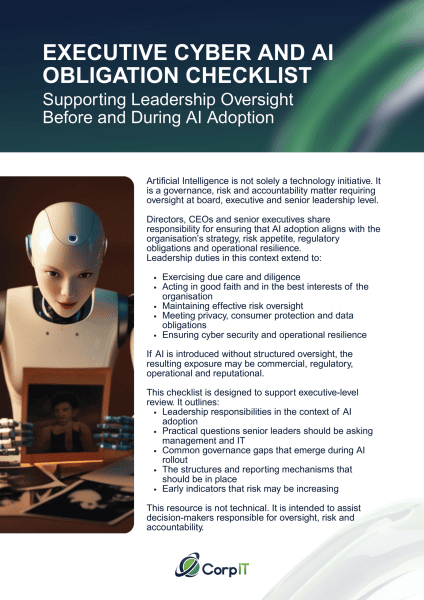
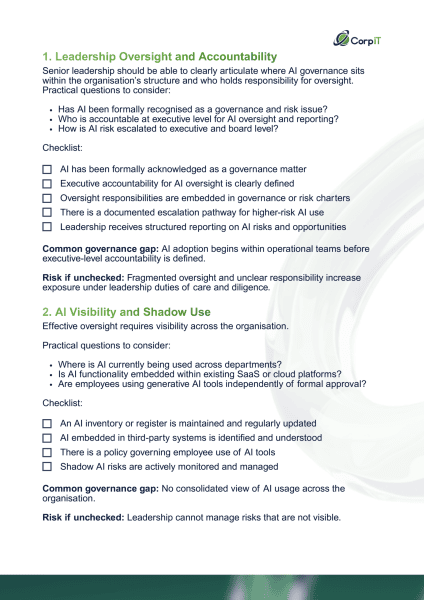
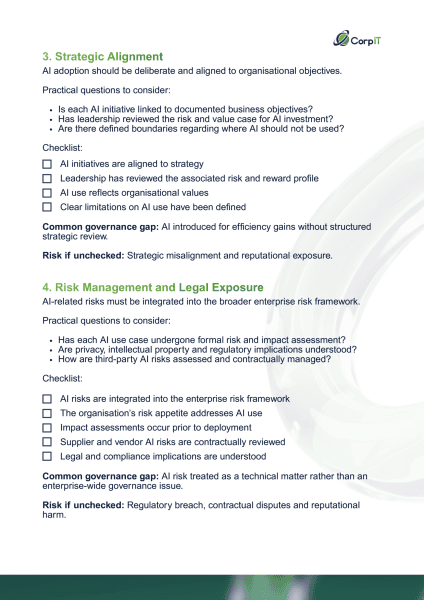
The Director and Executive Cyber and AI Obligations Checklist supports executive-level review.
It outlines:
Board and executive responsibilities in the context of AI adoption
Common governance gaps that emerge during AI rollout
Practical questions leadership should be asking management and IT
The structures and reporting mechanisms that should be in place
Early indicators that risk may be increasing
This resource is not technical. It is designed to assist decision makers responsible for oversight, risk and accountability.